Beyond speed: Building generative AI for the way creators actually work
Whenever a major technological shift hits entertainment, the first question often asked is: How can this make things faster and cheaper? However, from our perspective as content creators, that’s the least interesting part of the equation.
The real question is: What can an artist do today that was literally impossible yesterday?
This shouldn't be taken to imply that speed doesn't matter. It just means we’ve been measuring the wrong kind of speed. Velocity matters because the sheer number of reps is what separates an amateur from a pro. Great work rarely happens on the first pass; it comes from rapid iteration and exploration of edge cases.
It’s this kind of rapid iteration that enables creators to explore more ground. However, to unlock those possibilities in actual production, generative AI really needs an understanding of the world in which it is generating content. This is not just a world model requirement; it is a need for a full contextual understanding of the space, what’s in it, and how the elements interact.
Most generative tools weren't built for the way a linear, game, or immersive experience actually gets made. A model can generate a great image, but it has no idea where that image sits in 3D space, whether the camera angle in the next shot will match, or how that asset behaves inside a real production pipeline.
If we want to move past isolated experiments, we need tools built specifically for professional production. These are tools that ground generative models in 3D spatial truth and give creators much more influence over the result, all while maintaining strict control over who has access to the content and what they did with it.
That exact challenge is why we built OKO + Nodey.
Bridging generative AI and 3D production
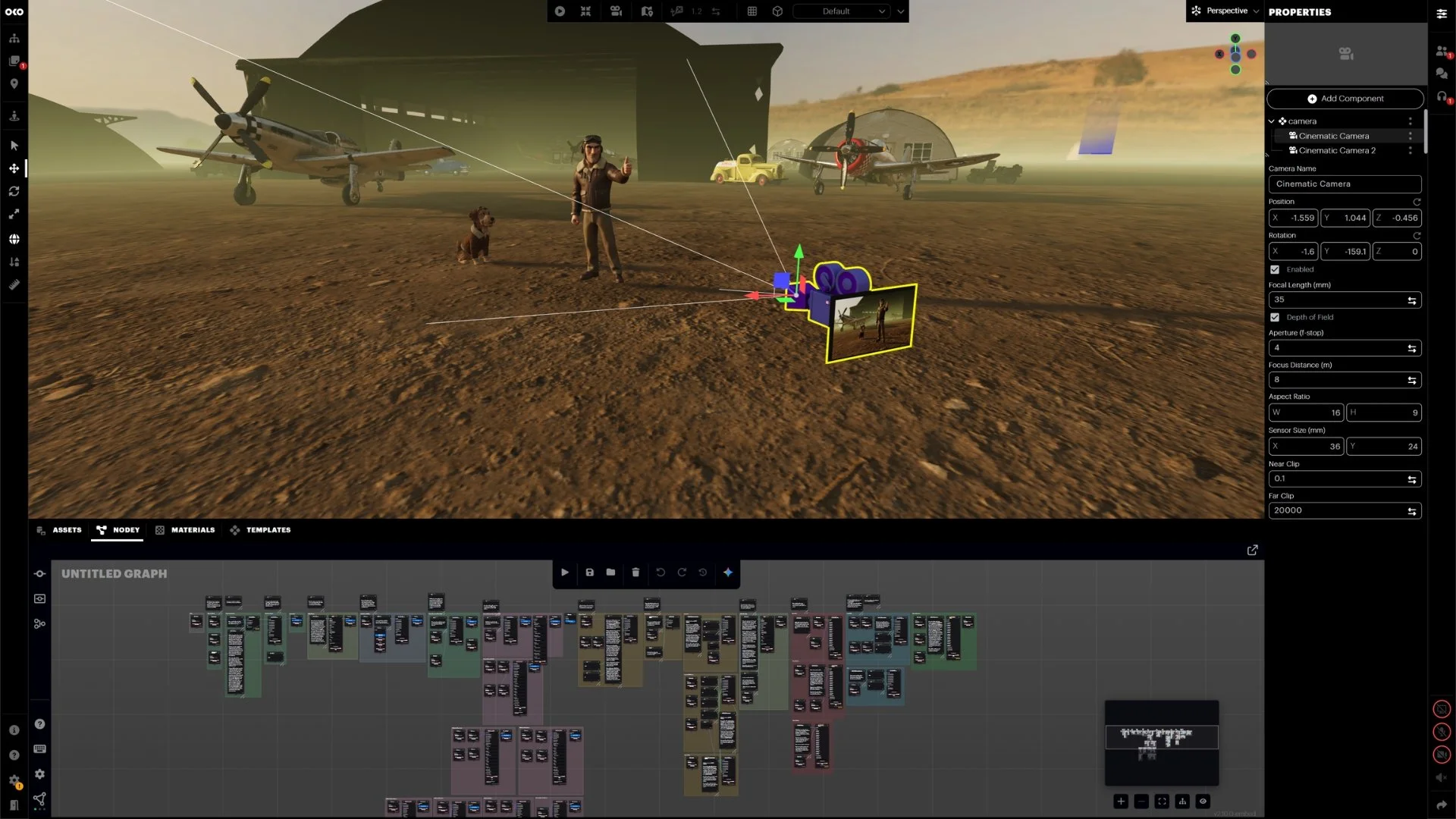
Generative models are incredible at creating visual assets quickly, but complex scenes require spatial awareness. Our architecture bridges that gap by using real 3D spatial data to guide generative workflows while giving creators control over the composition.
Instead of hoping a text-to-image prompt gets the camera depth or lighting right, Nodey uses OKO's spatial guardrails – using real-world 3D data like camera trajectories, Gaussian Splats, and Unreal Engine layouts – to lock down scale, lighting, and camera paths. This helps maintain visual continuity across sequences.
Built for studio pipelines, not isolated experiments
Jumping between browser tabs, separate subscriptions, and disconnected apps completely kills creative flow. Scaling content ops means pulling all those tools onto a single collaborative canvas. Bringing foundation models – like Google’s Gemini and Omni – together with over 1,200 specialized tools in one place creates a connected pipeline where assets, models, and teams work together naturally.
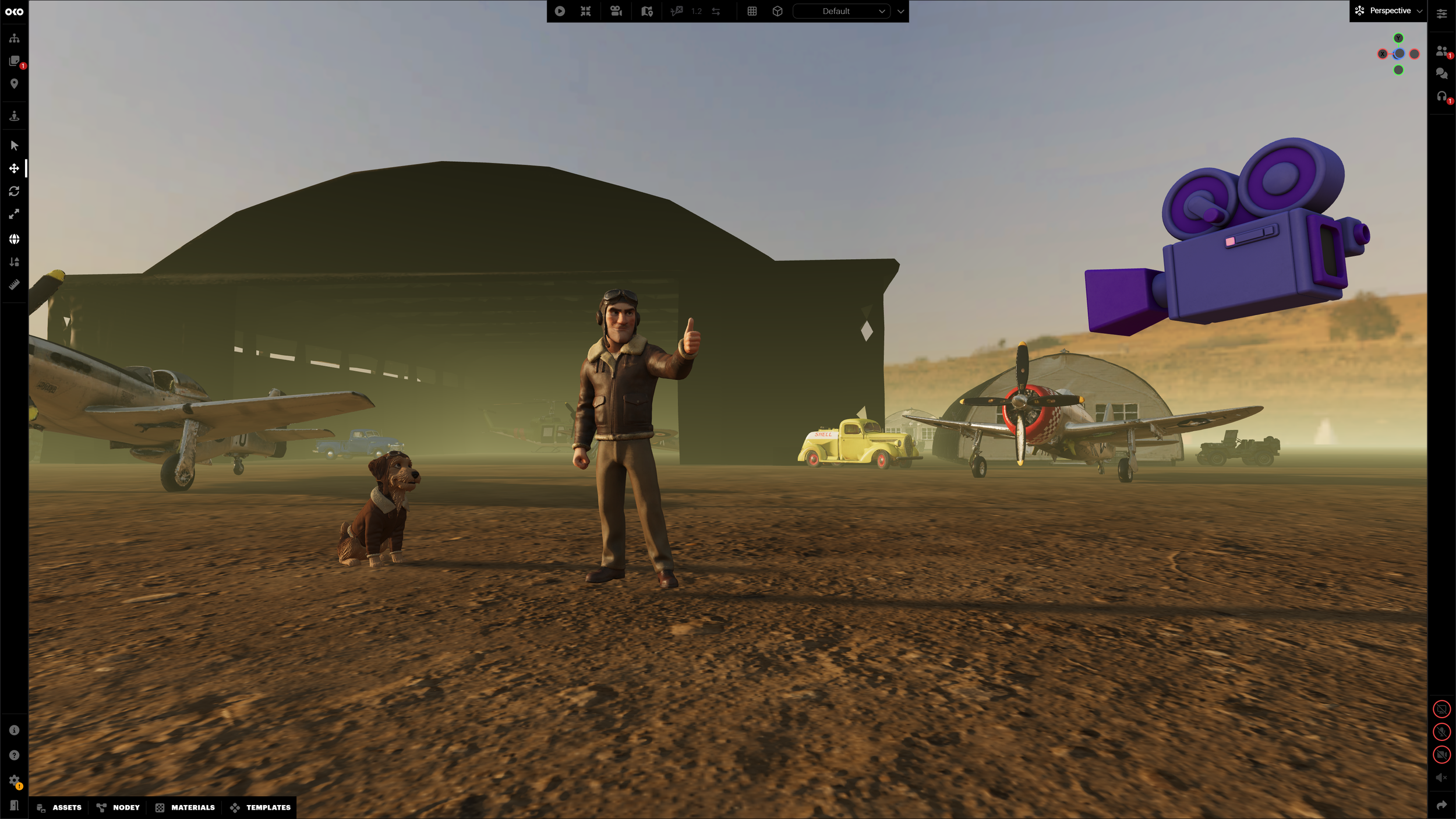
Using Omni in Nodey to direct multi-model AI video generation with persistent character, camera, and environmental control.
Visual control without local overhead
Node-based graphs have rightfully become the lingua franca for technical artists because they offer deep, step-by-step precision without locking anyone into past decisions.
Traditional desktop setups come with a lot of friction. Artists end up wrestling with software installs, broken plugins, and single-machine limits. Moving node graphs to the web browser means technical teams get that same deep visual control on any device, instantly, without wasting time playing IT support. In addition, they reap the benefits of nearly unlimited processing capacity.
Enterprise governance & IP provenance
Local experiments stop working the moment studio legal and security teams get involved. Commercial production requires strict governance.
Hosting each studio in its own isolated Google Cloud project ensures proprietary assets and prompts never leave the managed cloud. At the same time, the platform automatically logs every model, prompt, and input used along the way. All outputs are marked with C2PA credentials, and every artifact carries the graph that created it. Commercial arrangements with every available model ensure that no content is used for future model training. This gives legal teams the clear paper trail they need to safely approve work for commercial release.
Bring your own compute (BYOGPU)
In many cases, studios have already made heavy hardware investments. Whether running a rack of GPUs in a server room or hosting compute on another cloud provider, OKO+Nodey taps directly into those existing resources, giving production teams full web control without letting existing hardware go to waste.
Agentic collaboration & what’s live today
Underpinning our architecture is a simple philosophy: AI should magnify creative talent and discipline, not replace it.
We build AI agents to do the tedious backend work. The human artist stays in the director’s chair. By pairing smart automation with real craft, a single creator or small team can execute on fully formed ideas. Each team becomes a powerhouse of content creation.
What’s live in this release (and what’s coming next)
To make these workflows useful day-to-day, they have to live inside the tools artists already use. That’s why we’re connecting our tools directly into real-time engines and production pipelines.
Live now
Nodey integration in Unreal Engine: Bringing node-based generative workflows and agentic orchestration directly inside the real-time engine environment.
Nodey MCP: Connecting generative node graphs and pipeline orchestration directly to AI assistants.
OKO Unreal MCP: Enabling AI assistants to manage OKO spaces, place 3D entities, and upload assets directly inside Unreal Engine using simple prompt-based commands. Dive into the technical architecture in Bridging AI and Unreal Engine: Introducing OKO MCP Tools.
Nodey + OKO Web integration: Running Nodey graphs directly within OKO to pass data back and forth.
Rosie, the Nodey graph assistant: A conversational co-pilot that enables artists to work incrementally with an expert on the available nodes and potential workflows.
For a deeper look into how these tools bridge generative models directly with real-time engines, check out our full deep dive on Bridging AI and Unreal Engine: Introducing the OKO MCP tools plugin. INSERT URL
Coming soon
OKO MCP: Expanding 3D spatial context and engine intelligence across the broader DCC ecosystem.
Process agents: Nodes that encapsulate complex workflows, which can be used repeatedly and shared with the wider team.
Technology at the service of human storytellers
We’re creators building for creators. We didn't build OKO and Nodey to replace craft; we built them to remove the technical friction standing in its way.
When tools are designed specifically for the way production teams work, artists get to spend their time on what actually matters – running more reps, taking creative risks, and building things that were literally impossible yesterday.
To explore how OKO + Nodey fits into your studio’s pipeline, visit oko.live or find us on Google Cloud Marketplace.